There's a Devil in That Jug, Boys - part 2, 1900-1950
by Tim Campbell · first published 8 March 2018 · his original post
The year 1900 found the devil in the jug to be alive and well in Blooming Grove's glistening new location on the railroad, the town's new location being still only a little over a decade old. Passengers and tourists from the Cotton Belt depot visited on a daily basis and spent their money in the stores and shops as did the local citizenry and folks from the many surrounding farms for miles. Farmers would often bring their families to town and spend the whole day, especially on Saturdays. A 1900 map of the town shows 3 gins, a grist mill, five grocery stores, four dry goods stores, three drug stores, three stores that sold hardware and furniture, four blacksmith shops, two printing offices, two barbers, two restaurants, a photographer, a lumber company, a bank, and a tin shop. Of these the groceries and drug stores were able to sell liquor so long as the proper taxes were attached.
Meanwhile whiskey making and bootlegging around Blooming Grove was alive and well. By going a few blocks to the west of downtown or to the south through old Gradyville near the Carroll Creek bridge, you could buy whiskey much cheaper than in the stores in town, and without the tax, although it was not necessarily always of the best quality. One local fellow of the day remembered that when he was a boy he was awakened one summer night in the wee hours of the morning by a terrible noise in the backyard. Thinking it to be wolves among the chickens, the boy grabbed his squirrel gun and ran out the screen door to discover his poor father on his hands and knees howling at the moon and giving a grand chase to the yard fowl. It seems he had purchased a pint jar of moonshine from a still near the Carroll Creek Bridge and it had an unusually adverse effect on his behavior that night.
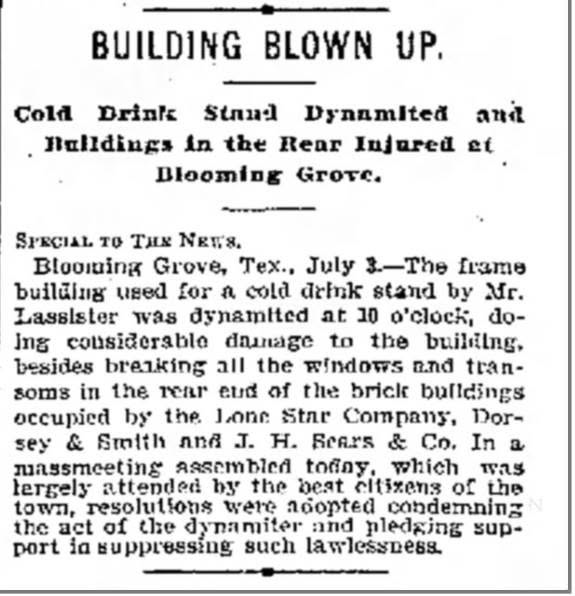
In 1905 a fellow named Lassiter had opened a stand in Blooming Grove where he was selling cold libations. If I am not mistaken he was from neighboring Frost. I believe his stand faced South Main Street in the block where the current bank drive through driveway is located. Whether they were upset about the sale of alcohol or were angry at Lassiter, perhaps as a competitor or personally, someone planted dynamite in the drink stand and blew it to smithereens in the middle of the night, damaging adjoining buildings in the process.
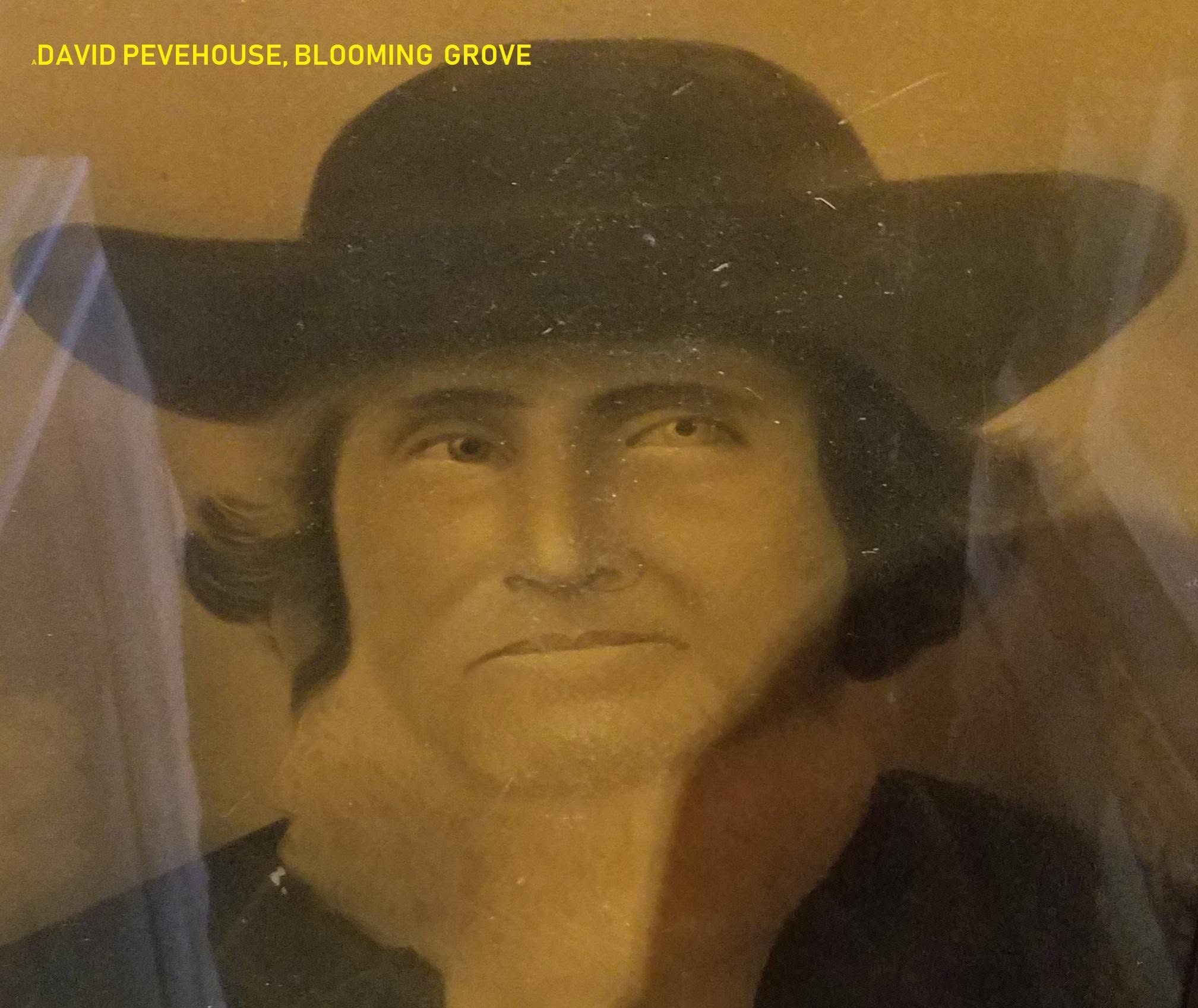
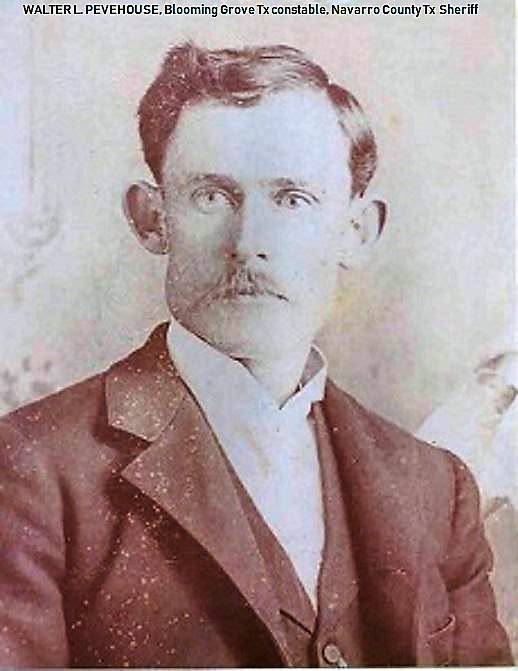
Law and order were in high demand in the Grove. Enter the Pevehouse clan. David Arthur Pevehouse, Jr., was born in Montgomery County, Republic of Texas, in 1845. He married a Navarro County girl and settled about 3 miles southwest of Blooming Grove. They had numerous children, and among these was one Walter Lavazier Pevehouse, born in 1876 near Blooming Grove. Sometime between 1901 and 1910 Walter became the city constable in Blooming Grove. He built a solid reputation among the locals as a quiet but stern and just lawman.
The two sides of prohibition locked horns for a number of years, but in 1911 things came to a head when a statewide election was called once again for statewide prohibition. This election was hotly contested locally. Large ads were placed in the local newspapers by committees supporting both arguments. One side was called the Prohibition Committee and the other side, believe it or not, was called the Anti Prohibition Committee. There were temper flarings and heated exchanges on the streets on a daily basis. When the dust cleared, prohibition was defeated once again, although this time the vote was very narrow.
About this point in time, law enforcement began to ramp up enforcement against illegal whiskey sales. Walter Pevehouse had been elected as Navarro County sheriff (he served from 1912 to 1916) and Henry Jones Mabry was the new constable for the Blooming Grove / Frost precinct in Navarro County. Mabry's arrests appear to be mostly "out of town" people that were in the territory purveying their liquid wares, while local operations were left mostly untouched. One day in 1915 Mabry had gotten on the Cotton Belt interurban train and ridden to Dallas. On the way home, a man, not knowing Mabry was a policeman, tried to sell him a pint of whiskey out of a case he was carrying. Mabry bought the whiskey, promptly arrested the fellow, then later commented that the whiskey was of very high quality and most enjoyable.
Eight years after the 1911 Texas election defeating prohibition, a nationwide prohibition law was passed by the adoption of the 18th Amendment to the U.S. Constitution. The State of Texas ratified it and then followed up with an amendment to the Texas Constitution in May of 1919. Prohbition had come to the nation and to Texas and to Blooming Grove.
Local law enforcement immediately began to search out, seize, and/or destroy certain whiskey stills, although enforcement appears to have been somewhat selective. In 1920, Navarro County officials seized a 50 gallon still near Mill Creek, to the north of the Grove. No arrests were made, and the still was turned over to Mart Warren, constable at Blooming Grove at the time.
In 1921 only a few buildings had gone vacant in Blooming Grove. The business community still boasted two automotive garages, a fresh produce shop, two barber shops, five grocery stores, three dry goods stores, two banks,a confectionary, two restaurants, two drug stores, a blacksmith shop,a feed store, a movie theater, a cobbler, a meat market, two hardware stores, two tailor shops, a furntiture store, a mattress factory, a railroad station, a hotel, three cotton gins, and a lumber yard.
In 1928 Blooming Grove's native son, Rufus Pevehouse, the son of aforementioned old time lawman Walter Pevehouse, was elected to the Navarro County Sheriff position. Rufus made the battle against illegal whiskey production a top priority from the time he was elected in 1928 through the end of prohibition in 1933. He and his deputies conducted many, many raids on bootleggers and almost completely extinguished the practice of distilling moonshine in Navarro County during his tenure. He served 5 consecutive 2 year terms from 1928 to 1938. When he was defeated in the 1938 election he went to Dallas and became a U.S. Marshall. In 1950 he ran again for Navarro County Sheriff and won, then held the position another 23 years before finally retiring.
In the photos attached to this article can be seen four of the many whiskey stills raided in Navarro County. Sheriff Rufus Pevehouse is pictured in at least two of them and probably was involved to some degree with all four.
By 1933 the nation's lawmakers had come to the realization that first of all, perhaps prohibition was not exactly the best thing for business, as the nation was in the midst of its worst economic collapse since its inception, and secondly, it really didn't matter how many laws they passed against liquor, folks were simply going to make it and sell it and drink it anyway. Not only did the homemade, illegal variety of whiskey produce no tax revenue, it was unregulated and could be harmful, sometimes lethal, to imbibing parties. By the time the Great Depression reared its head in 1930 and prohibition had ended in 1933, Blooming Grove's business community was a mere shadow of its former self, and even with the eventual paving of Highway 22 and FM 55, has never returned to its heyday.