The booklet from the auction
by Tim Campbell · first published 27 May 2019 · his original post
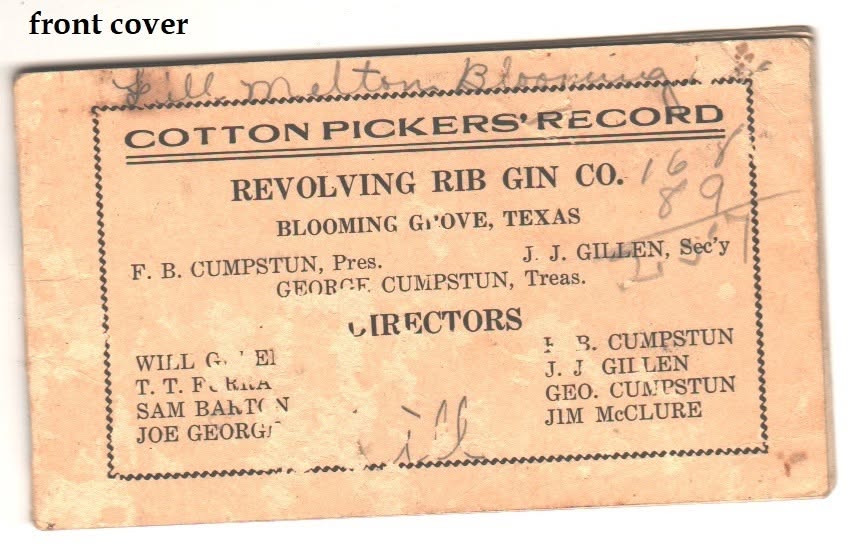
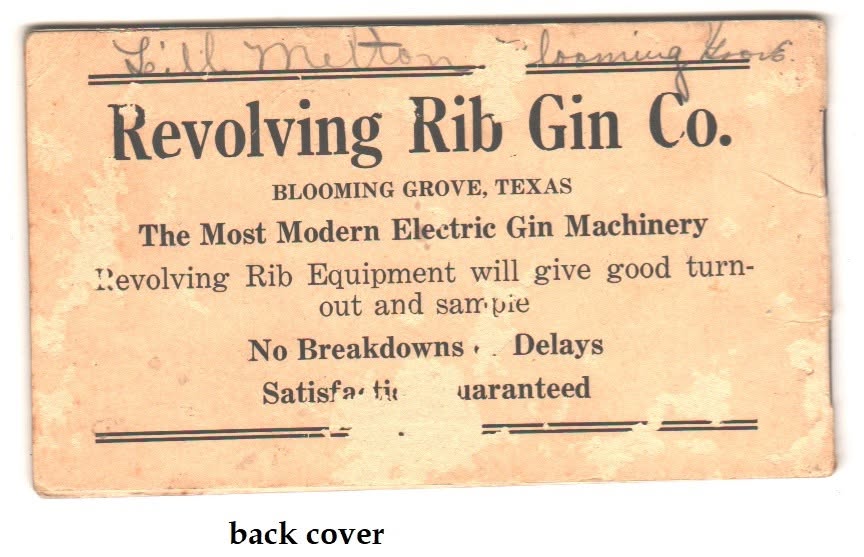
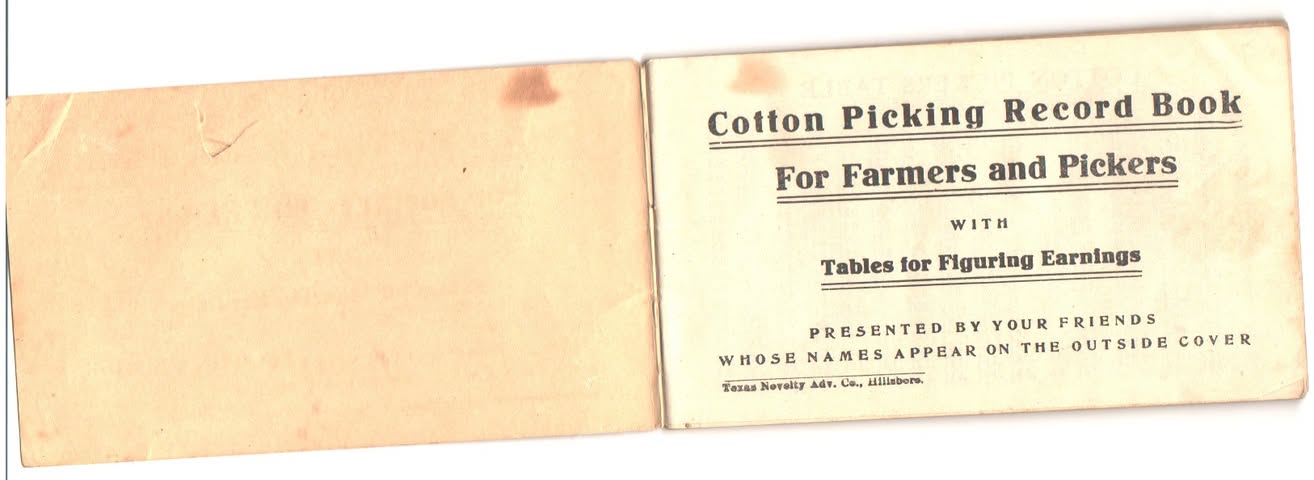
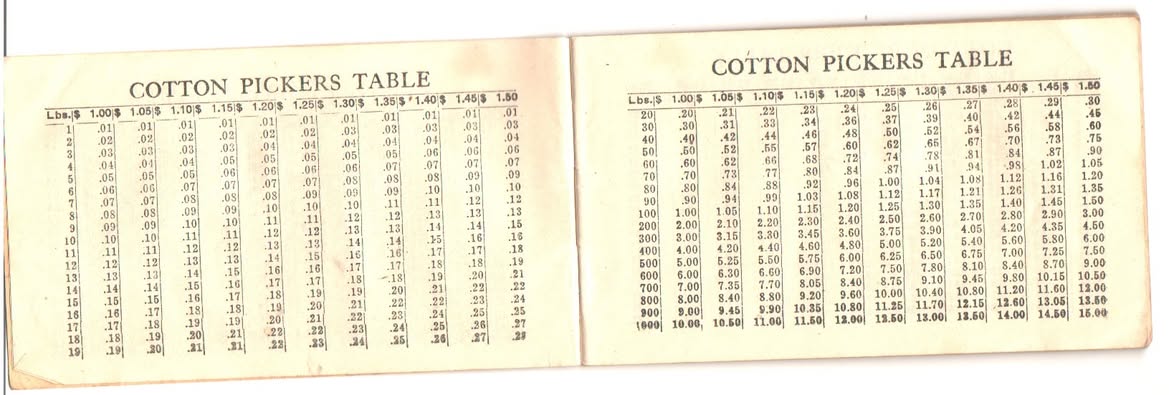
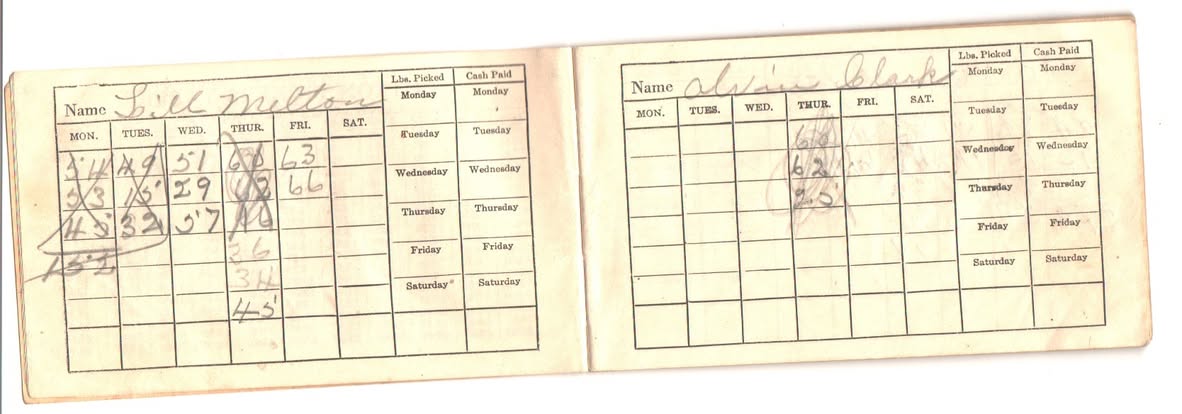
I was fortunate enough to find the attached booklet at auction a few years back. It is an advertising media that was given out at the Revolving Rib Gin in Blooming Grove to patrons sometime between the mid 1920s to the mid 1930s, when it succumbed to the Great Depression and several lawsuits. Gin officer Daniel George Cumpston passed away in 1927, therefore these booklets were probably printed in bulk between the gin's inception in 1923 and 1927 when George passed away. The booklet was printed in Hillsboro, Texas by the Texas Novelty Advertising Company, who misspelled the name Cumpston on the cover. In the booklet, cotton pickers could maintain a record of their daily picking totals. This booklet belonged to Lill Melton of the Dresden area. Lill recorded his own cotton pickings in the book as well as other pickers, all of whom were probably picking on Lill's father's cotton farm. More to follow later about the cotton pickers.
Blooming Grove's Revolving Rib Gin was developed by Fred Cumpston here in the early 1920s. Fred was born in 1879, and was the son of Irish immigrant Henry Cumpston (1830-1916) who came to the Blooming Grove area from Chicago after immigrating to that city from Ireland. Henry Cumpston, according to oral family history, was a "powder monkey" in Chicago, which means he worked with dynamite. He is said to have been employed blowing up buildings to help stop the great Chicago fire which raged for 3 days in October 1871, destroying approximately 17,500 buildings. After the fire he and wife Ellen (also a native of Ireland) headed for Texas, where Ellen is said to have had relatives. Ellen's maiden name has been listed both as McLachlan and Cunningham, not sure which is correct. This couple had five children, being James Henry Cumpston (1875-1948), Daniel George Cumpston (1877-1927), Frederick Bernard Cumpston (1879-1962), Mary Honerdell Cumpston (married Charles F. Lewis)(1880- ), and William Frank Cumpston, b 1888. Fred was married to Flora Campbell, daughter of William Furra Campbell and Dora Howard, and was thus your author's great uncle. Fred was gifted with an amazing ability to create new and better ways of doing things at a time when the mechanization of America was in full swing. He patented his first invention at only 26 years of age. He invented several important machines prior to the Revolving Rib. He invented the "automatic gin packer", the "cotton cleaner", and the "automatic cotton compress", which was sold to the Contintental Gin Company of Dallas. Attached are several interesting drawings for patents submitted by Fred Cumpston. One of his investments after selling some of these patents was his purchase of the Alamo Hotel in BG, which sat next to the gin on HInkley Street.
The Revolving Rib Gin was credited with revolutionizing the American cotton ginning industry, and is still referred to in cotton ginning circles today, even though Fred failed to profit significantly from it. As the attached newspaper clippings suggest, Fred used his patented gin mechanism in building a magnificent gin in Blooming Grove at a cost of $25,000 to $30,000. It was located on Hinkley Street, just south what is now the Blooming Grove Fire Department, where some apartments are now located. The 3 officers of the Revolving Rib Gin were brothers Frederick Bernard Cumpston and Daniel George Cumpston, as well as James Jackson Gillen. Directors in addition to the 3 officers included Will Green, Thomas Tell Furra, Aaron Samuel "Sam" Barton(1875-1943), Joe George, and Jim McClure.
Daniel George Cumpston (1877-1927) , Fred's brother, died in 1927. It is difficult to read, but his "cause of death" appears to say "exposure to much drink" or something to that effect. He never married. James Jack Gillen (1865-1943) was a native of Mississippi and migrated from that place to Navarro County about the year 1900. He was the father of local legend "Daddy Drew" Gillen. Will Green (1849-1948) was a farmer in the Lone Oak community north of Blooming Grove. He lived to be 99 years old and is buried at Lone Oak Cemetery. Thomas Tell Furra (1875-1955) was the son of William Richardson Furra and Martha Rogers of Nacogdoches County, Texas, and was a 2nd cousin of Fred Cumpston's wife Flora Campbell. Tell Furra had a farm east of Dresden. He was married to Mary Brister. Family oral history says Tell ran away from home in Nacogdoches and came to Navarro County, following his Campbell cousins who had moved there. Aaron Samuel "Sam" Barton (1876-1943) was the son of Aaron Terrell Barton and Margaret Griffin. He had a farm in the Lone Oak area. He was married to Kate Sanders. Jodie Newton "Joe" George (1892-1973) was the son of Dr. Isaac Newton George and Carrie Wilson of Cryer Creek. In 1920 he was living with his widowed mother and siblings at Cryer Creek. In 1930 he was living at the Thrash Hotel in Blooming Grove and his occupation is listed as a cotton gin owner. James Newton McClure (1872-1956) was born in Missouri to Finis Ewing McClure and Mary Williams, and migrated to Texas with his parents as a child. He was married to Nancy Callie Thompson. I believe he lived in the Lone Oak vicinity.
The Revolving Rib employed a number of young men in Blooming Grove in cotton ginning season. Fred's grandson recalled going to the stores in BG and buying candy after school, then going to his grandfather's gin, where some of the young workers would take his candy. So one day he bought some "chocolates" that were actually something along the lines of Exlax, and went to the gin, where his "candy" was promptly stolen and eaten by the older boys working there. The gin had to close early that afternoon due to so many workers going home "sick".
Fred's gin did not survive the Great Depression and he eventually sold his patents to larger ginning companies in Dallas. Part of these deals involved Fred receiving royalty payments related to his inventions. One particularly large buyer of Fred's patents did not keep up their agreement to pay royalties. It is said that Fred made a yearly trip to Dallas for many years afterwards where he would hide at this business with a baseball bat, beat up one of the perpetrators who fleeced him, and return promptly to Blooming Grove.
As for the pickers whose names are scribbled in the Cotton Picker's Record: Lill A. Melton was born in 1902 at or near Dresden, Navarro County, Texas. He was the son of Carter Melton and Ella Lewis. He was the grandson of Ethan Melton, a founding father of Dresden. "Lill" is a variation of the old Melton family name "Eliel". The Eliel Melton who died defending the Alamo in San Antonio was a relative of the Meltons of Dresden. Alvin Troy Clark (son of William Brinston Clark, blacksmith, of Dresden and wife Mattie King) was born in 1905 at Dresden, Texas. Alvin's older brother, Lester Clark had a store near Dresden at the corner of what is now NWCR 4010 and FM 55, just south of the red brick house where Lill Melton lived for many years. Attached is a photo of the old Clark store at Dresden. William Brinston Clark, father of these Clark boys, was a well known blacksmith of the area for many years. Alvin married Leona Moody about the year 1925 and , perhaps after picking enough cotton to make a stake in his business venture, moved to Corsicana, where he was a barber for many years. (William) Arthur Clifton, Fay Clifton, Louise Clifton, and Ruby Clifton were all children of Thomas Ezra Clifton and Ollie Josephine Downing, who came to Texas from Tennessee about the year 1908. Their ages about the time they would have been picking this cotton would have been about 20, 18, 14, and 12. This Clifton family settled at Frost, Tx. William Arthur Clifton went on from the cotton fields to become a Sergeant in the U.S. Marines. Elvie Fay Clifton married Curtis Morgan Helms in 1945. Louise Clifton married Harry Ernest Skinner in 1940. Ruby Dee Clifton married John Thomas Rawlings about 1933. Ernest Carter Melton was Lill Melton's older brother. He married Maldonia "Donia" Hunt. In 1930 their boys, Ervin and Ethan would have been 14 and 12 respectively. It was not at all unusual for children as young as 6 or 7 years old to labor in the cotton fields. As for the "Minyard" that is listed, there was a family of Menyards in Corsicana in 1930. Probably this picker was an itinerant picker, i.e. was just in the area for a while to get work picking cotton and then would move on. No one by this name appears on any census records near Dresden. Mr. Carter's Children - I believe this almost certainly refers to Lander Clarence Carter and William "Junior" Carter. They were sons of Clarence Carter and Edna Frances Ewing. The following story was related to your author several times by his mother, Edith Ewing: Clarence Carter was a "traveling salesman" who met and married Edna Ewing, daughter of Ed Ewing and Ina Shettlesworth, near Dresden, about the year 1927. Edith Ewing was 6 years old when the wedding was held in the front yard. The Ewings lived just east of the site of the old Ethan Melton home on the North side of what is now NWCR 4010. Ed and Ina Ewing were somewhat upset that their daughter was marrying Clarence but agreed to host the wedding. Edith remembered that just as the couple were saying their vows, a strange noise was heard coming from the nearby woods. It sounded like a loud hideous scream and got closer and closer, sounding as if it were traveling along the fence row. Then it just stopped and nothing more was heard. Ina Shettlesworth Ewing declared it to be a very bad omen.
Five years later, Edna had given birth to sons L.C. and Junior, as the family called them. Clarence Carter had moved Edna and the children to Troup, Texas, far away from Edna's parents and family home. Edna was pregnant with a 3rd child when she caught pneumonia and delivered prematurely. As she lay dying and crying for her mother, desperate phone calls were made to "Granny Melton's" home, which was the nearest telephone. The Ewings could do nothing but mourn as the roads were too muddy to travel and Edna was in such a state that she would be dead by the time they arrived even if they attempted to make the trek to East Texas. She was buried in a lonely pasture near Troup. A few weeks later, a Model T ford arrived at the Ewings house, and LC and Junior Carter, ages 4 and 1, were left at the end of the Ewing's driveway. The car drove away and "Mr. Carter" was not heard from again. The two Carter boys were raised by the Ewings, and grew up to serve their country very ably in the U.S. Military. After their military work, both boys became very successful businessmen. They returned to Blooming Grove often to visit the Ewing family, never forgetting their roots here and their humble beginnings. They located their mother's grave near Troup, Tx and placed a marker there.
It is amazing to note all of the history that can be gleaned from a little complimentary booklet given away as advertising by a cotton gin 90 or so years ago. There is not a Cumpston left in Blooming Grove now as their descendants are scattered across Texas and elsewhere, but the name here is repeated again and again when it comes to the family's legendary wit and ingenuity, and sometimes mischief.
This piece was published without a title. The one above was written here; the words below are his.