I'm Not Puttin' My Money In No Dadgum Bank
by Tim Campbell · first published 3 May 2018 · his original post
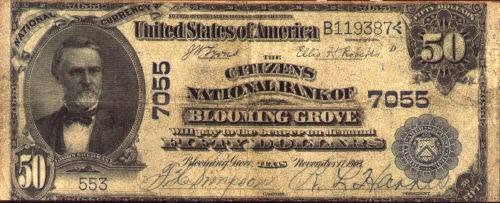
Some might find it hard to believe that there was only one chartered bank in the entire State of Texas prior to the Civil War. This was the Commerce and Agricultural Bank which opened in 1847 in Galveston. The first nationally chartered bank to operate in Texas was the First National Bank of Galveston, established in 1865. From 1865 to 1900 the banking industry in Texas slowly but steadily grew. State chartered banks were mostly prohibited. As of 1880 there were still only 13 nationally chartered banks in Texas. As a result there were a great many "private banks" which were basically unregulated but very necessary due to the massive growth of the cotton industry and other mercantile businesses. By 1905 there were 440 of them. In the 1890s there arose a movement for state chartered banks and the state charter system was in place by 1905. . People who deposited funds with these banks did so at their own risk. In 1907 there arose a call for a "guaranty fund" for Texas banks. The Dallas Morning News led a campaign for the passing of this law, and in 1909, the famous William Jennings Bryan addressed the state legislators urging immediate approval. The guaranty law took effect in January 1910 which allowed state banks to participate at their option in a guaranty fund, whereby they paid a percentage of deposits into the state fund. Should a bank fail, the fund was theoretically to bail out the failed bank, and if necessary, additional assessments would be made against member banks to bail out the failed bank. The other option was that banks could post or "set aside" bonds equal to their capital to secure their depositors.
In the 150 or so years that the Blooming Grove / Gradyville community has been around, it has had 6 chartered banks. The First National Bank of Blooming Grove, which opened in 1892, was the first bank in town. While it would have been possible for there to be a private bank in operation prior to that point, there does not appear to have been one. According to the census of 1880 there were no bankers in Blooming Grove at that time.
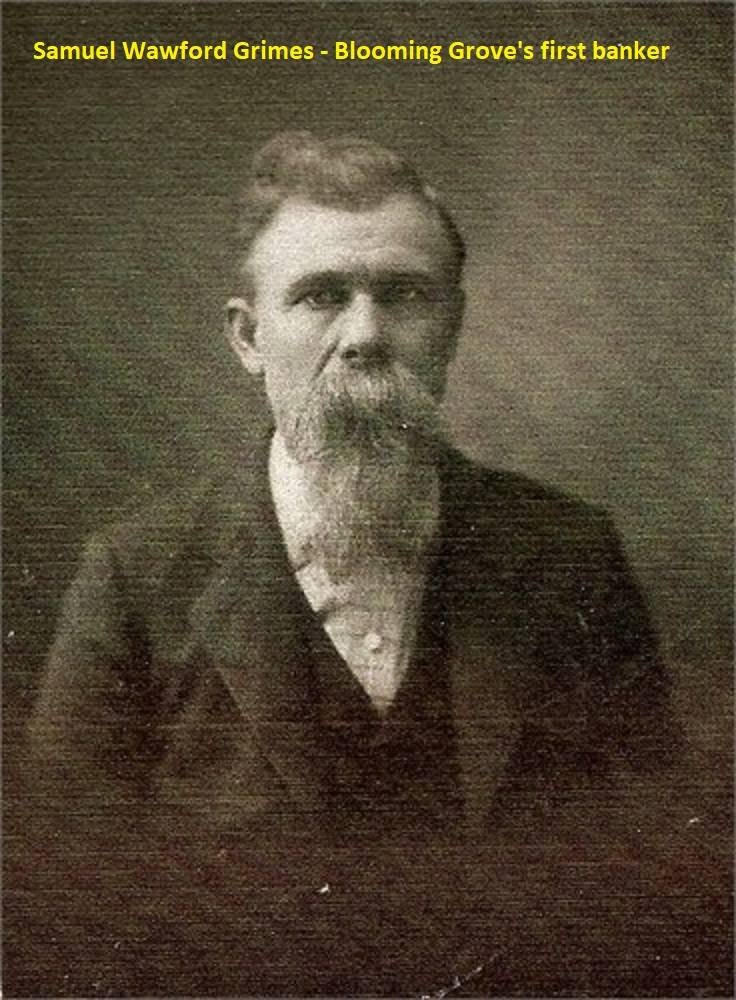
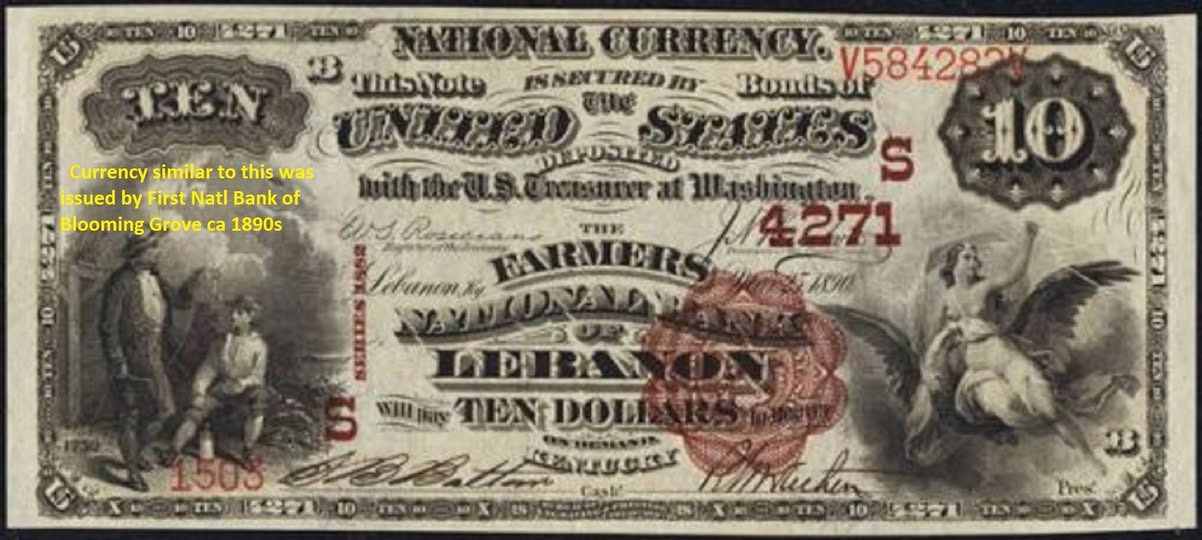
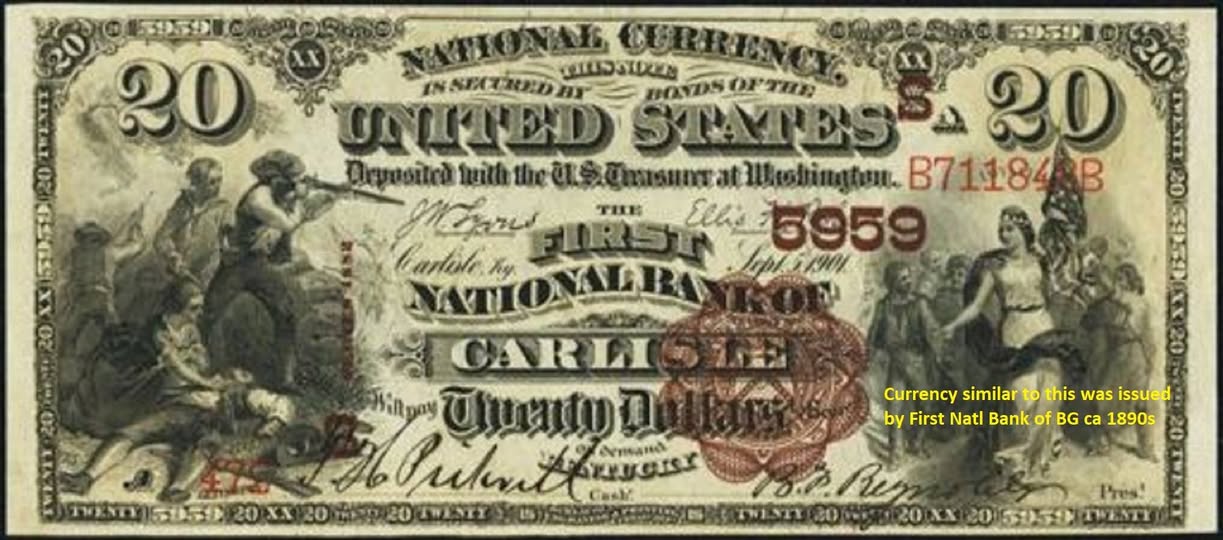
It was stated in an early history of BG written by R.W. George, that Samuel W. Grimes, a merchant, was Blooming Grove's first banker. He was named as the first president of the newly formed First National Bank of Blooming Grove in 1892. This bank was located in the grassy area between the present day "Station" Cafe and the "Grapevine" shop, on the East side of Fordyce Street. In the 1890s banks could print and issue their own currency using a standard design for national banks. FNB Blooming Grove is recorded as printing 668 sheets of "1882" ten dollar "brown backs" as well as 668 sheets of "1882" twenty dollar "brownbacks". 1882 refers to the year the bills were designed, not the year they were issued by federal banks. There were three $10 bills to a sheet but only one $20 bill to a sheet. Examples of "1882 brown backs" are included among the photos attached to this article. I have never seen a brown back from Blooming Grove, but if you find one, it should look similar to these. First National Bank of Blooming Grove stopped printing money in 1900, and appears to have been open only about 9 years. In 1894 a $25,000 lawsuit was filed against the bank by a Mr. Cohn. Whether the suit was successful is not known. In 1899 robbers attacked the bank but did not get away with any money. The bank appears to have closed not long after the turn of the 20th century. Currency issued by this bank bearing the name First National Bank of Blooming Grove is very rare and highly valued and sought after by collectors, including your author.
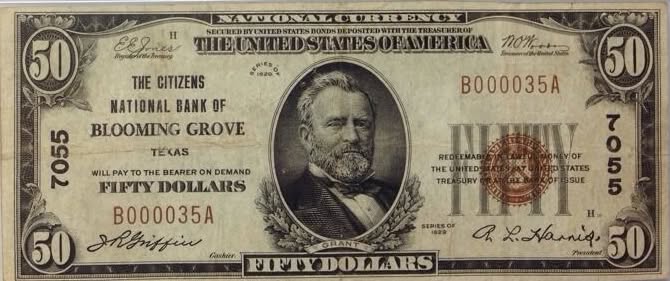
In 1903 a new bank charter was approved for Citizens National Bank of Blooming Grove. Matthew Garrett Young was the first president, Benjamin Hartzell was Vice President, and Roger S. Loyd was named Cashier. Young was the former cashier of First National Bank. This bank was located where the lobby area of the current Prosperity Bank is located on the West side of Fordyce Street. and in fact the beautiful wooden teller windows of this old bank are still in use today, although the upper portion with the iron teller cages were removed many years ago. A few years ago I had the extreme luck to come into possession of the old wooden phone booth that was used for years in the Citizens National Bank of BG. It was in shambles but I restored it and am using it as a closet in the old Greene home on Kerr Street.
As mentioned earlier the state charter system for banking was in place beginning about 1905. This set the stage for the arrival of some competition for Citizens National Bank. In May of 1909 the First State Bank of Blooming Grove was chartered. This bank appears to have been in business only three months as it was dissolved in August of 1909. Original stockholders were L.E. McCormick, F.H. Simpson, F. N. Drane, R.N. Elliott, and S.M. Kerr. Simpson was from Blooming Grove, and all the other stockholders were from Corsicana. Less than a year later, Citizens National saw a more formidable opponent arrive on the streets of Blooming Grove. The Blooming Grove State Bank was chartered on May 19, 1910. The first president was Jessie Homer Whorton. The Vice President was James Alphonso Smith, the cashier was Robert Lawson Harris, and the assistant cashier was John Richard Griffin. Whorton was born in Georgia and came to Blooming Grove when he was about six years old. At the time he helped start the bank he was also operating a general store and running cattle on a farm. Smith, a native of Pontotoc, Mississippi, operated a grocery store while also serving as vice president at the bank. Harris and Griffin were both natives of Navarro County, Harris being born at old Cottonwood (now a ghost town) southwest of Barry, and Griffin being born near Dawson, Texas. These men would be the core of the bank operation as it began to grow. Later on, Griffin became president of the bank.
In 1918 Justin Oliver McSpadden, a bright young native of Blooming Grove was added as the Blooming Grove State Bank's assistant cashier. H.F. Chestnut was added as a cashier. In 1920 Blooming Grove State Bank acquired the old First National Bank building, directly across the street from Citizens National Bank. It was beautifully refurbished and said to be quite a showplace. In 1922 the bank's ownership went through a change. Chestnut retired in 1922 and S.M. Woodard became a stockholder and acting cashier. Woodard, a native of Winnsboro, Texas also owned the Blooming Grove Telephone Company. In 1926, Blooming Grove State Bank was acquired by Citizens National Bank across the street, and BG was again down to just one bank. The great market crash came and went in 1929 and still the bank kept operating for a while. But not long thereafter it was announced that there would be a bank holiday. The operators of the bank shuttered its doors, and when it came time to open the next morning, it did not. Depositors, rich and poor alike, lost any money they had in the bank.
Edith Ewing Campbell, born near BG in 1923, remembered the day Citizens National Bank failed vividly. Her parents, Ed and Ina Ewing, were poor sharecroppers who were trying to feed a very large family, living just south of Blooming Grove. Edith recalled that she walked out the back door of their little house to discover her father sobbing bitterly on the back steps. What little savings the family had were entrusted to the bank and were now vanished. She said it was the only time in her life she ever saw her father cry.
For the first time in 3 decades, there was no bank in town. The Great Depression had come to call. The citizenry in general had very little money to put in a bank, even if the town had one. The school produced a yearbook in 1928 and did not produce another one until the 1940's. The railroad closed down. Times were tough in the Grove but the people here pulled through, raising gardens and butchering livestock to feed their families, and helping out neighbors when they needed help.
In May of 1935, the Corsicana Daily Sun recorded that a new bank had been formed by 35 to 40 citizens of Blooming Grove. The article pointed out that although the new bank was in the same building as the old Citizens National Bank, it had absolutely nothing to do with the old bank, which left so many of the BG citizens penniless. Although the familiar "I ain't puttin' my money in no dadgum bank" could be heard along the streets and on the "spit and whittle benches" around town, it didn't take long for the bank to gain the trust of the citizenry. Bruce McCormick is listed as the first president of First State Bank. All the time I was growing up in the 1960s and 1970s, the president was a fellow by the name of Bobby Ralston. First State Bank seemed to always be among the first to sponsor worthy causes in the community. A few years ago it was purchased by Prosperity Bank, which I believe is among the largest banks in the state.